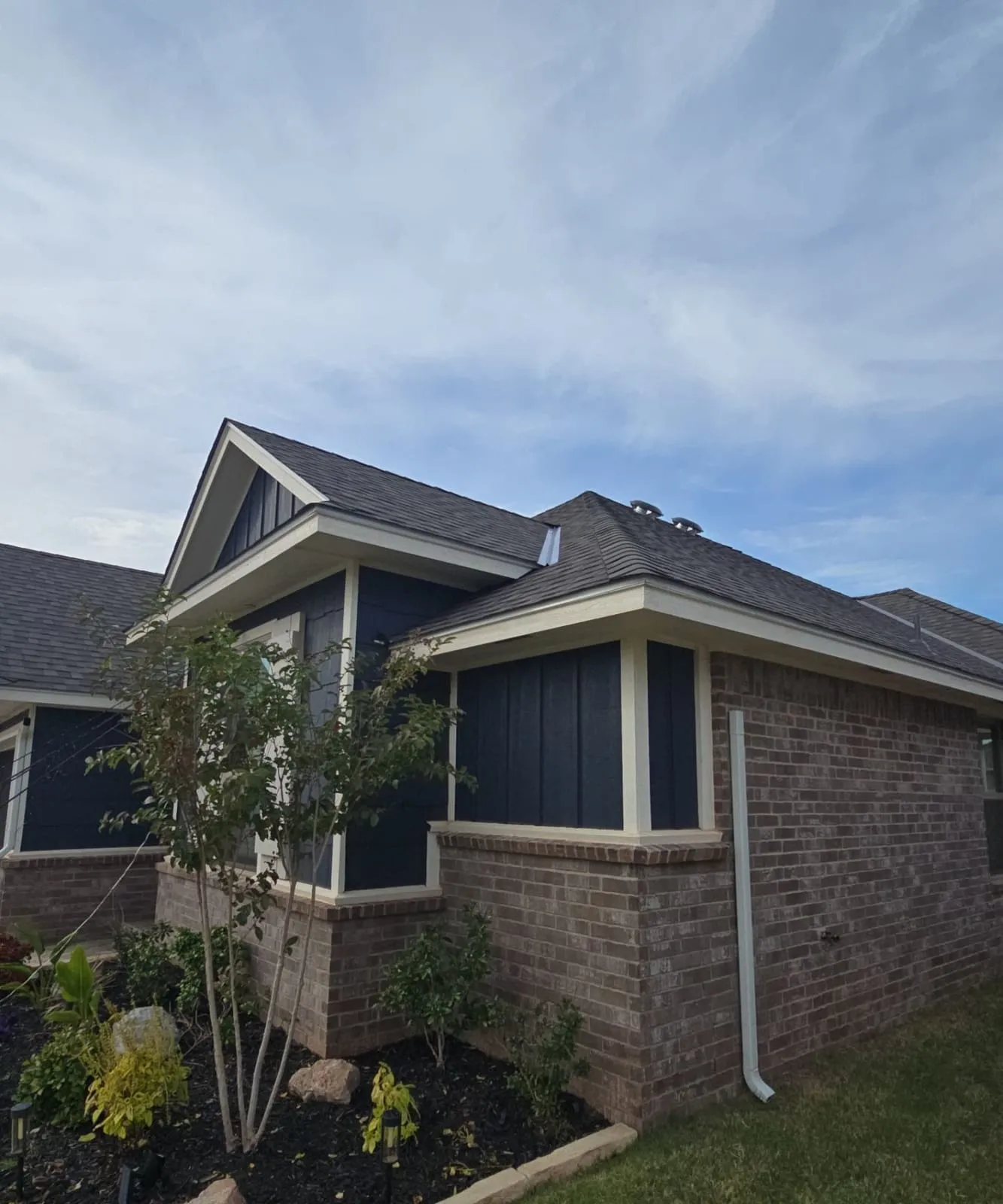
A roof valley is the inside corner where two slopes meet. Water from both planes runs into that line, so the valley carries more water than a single field of shingles. On a Yukon job, the valley metal is in place. That is the fact this page is built on. It does not name a metal brand, it does not give a start-to-finish replacement timeline, and it does not add other work that was not recorded.
What a valley has to do
Shingles shed water downhill. Where two downhill directions meet, the water joins. In a hard Oklahoma rain, that joint can run full while the rest of the roof still looks ordinary. Leaves from a nearby tree, granules from aging shingles, and ice in a cold snap all collect in the same trough.
Valley metal is the metal lining in that trough. It gives the water a continuous channel off the roof and puts a durable layer under the cut edges of the shingles. The shingles still cover most of the metal. What you often see from the yard is a narrow line of metal at the bottom of the V, or no metal at all if the shingles close over it. Hidden does not mean missing. The point of the metal is the path under the shingles, not a stripe you can admire from the street.
Open valleys leave more of the metal visible. Closed valleys weave or cut the shingles across the metal so less of it shows. Both are ways of using the same idea: the water should stay on top of the roof system and leave at the eave, not slip sideways into the deck at the joint. Which style is on a given house is a job detail. This page does not assign a style beyond what the Yukon photo shows, which is the roof with the valley metal placed.
Why Yukon roofs notice valleys
Yukon sits on the west side of the Oklahoma City metro, where wind has a longer run at ridges and rakes, and the same spring hail reaches the slopes. A valley does not get a different climate. It gets more water from the climate the whole roof gets. Hail can bruise the shingles that line the valley. Wind can lift the tabs that lap the metal. Debris from mature trees can dam the channel so water stands against the cut edges.
None of that, by itself, says a valley has failed. A mark on a shingle is a reason to look, not a reason to assume the deck is wet. The Yukon note is narrower than a storm story: the valley metal is placed. The photo is that roof, a brick house with shingled planes meeting, taken from the yard. It shows the valley. It is not a punch list of everything else on the house.
Roofing in Yukon is a residential service from the Oklahoma City office. Edmond, Norman, Moore, Mustang, and Oklahoma City are the other cities with their own pages. The valley detail is the same idea on those roofs. The published job photo is Yukon.
What was recorded, and what was not
The job record says the valley metal is placed. That is enough to talk about the detail. It is not enough to invent the rest.
This page does not name a manufacturer for the metal or for the shingles. It does not say when a tear-off started, how many days the crew was there, or what else was replaced. Gutters, vents, and siding can appear in a yard photo because they are part of the house. Their appearance is not a claim that those pieces were in the scope.
If you are comparing this with a full roof replacement, read that page for what a residential tear-off includes. Do not treat this Yukon note as that scope written small. A valley can be part of a replacement. It can also be the detail someone is pointing at on a roof that is already there. The sentence we have is the metal in the valley, in place.
What you can check from the ground
Stay off the roof. A valley is a slick place to walk, and foot traffic in the channel scuffs the shingles you are trying to judge.
From the yard, in daylight:
- Look up the line where two slopes meet. You may see a strip of metal, or only the cut edges of the shingles.
- After a heavy rain, see whether water is still standing in that line or pouring over the eave in a sheet.
- Check the ceiling under that part of the house for a new stain, especially after wind-driven rain.
- After a storm, look for shingle pieces or a pile of granules at the downspout that serves that slope.
Photograph the valley from the ground and the ceiling if there is a stain. Note the date. Do not spread roof cement down the valley from a ladder. A thick smear of cement can dam the channel and hide the edge that was actually open.
If you cannot see metal, do not conclude it is missing. Closed valleys hide it. If you can see metal that is bent up, rusted through, or flapping, that is worth an inspection. So is a stain that lines up with the valley and grows after each rain.
When an inspection is the next step
Call when water is inside, when a valley stain is new, or when hail has marked the shingles along that joint. Roof inspections are free for homeowners in the Oklahoma City metro, including Yukon, with no obligation. The crew looks at the valley, the metal, and the shingles that lap it, and says whether you are looking at a repair, a larger roof project, or a roof that can stay.
You do not need a brand preference before that visit. If the valley metal is the whole issue, the conversation stays on that detail. If the field of shingles around it is used up, the valley is one part of a bigger roof, and that should be said separately from a single flashing repair.
Active drips do not wait on a weekday. Call 405-795-8700. The line is open 24/7. For a dry stain you want read before the next storm, use the inspection request and say the house is in Yukon.
The Yukon photo remains a picture of valley metal in place, where two slopes meet and the water has to leave the roof. That is the job fact. Everything else on a valley is general roofing, not an extra claim about this house.
yukonvalleyflashing Roof replacement
Related: Roof replacement Roof inspections Yukon